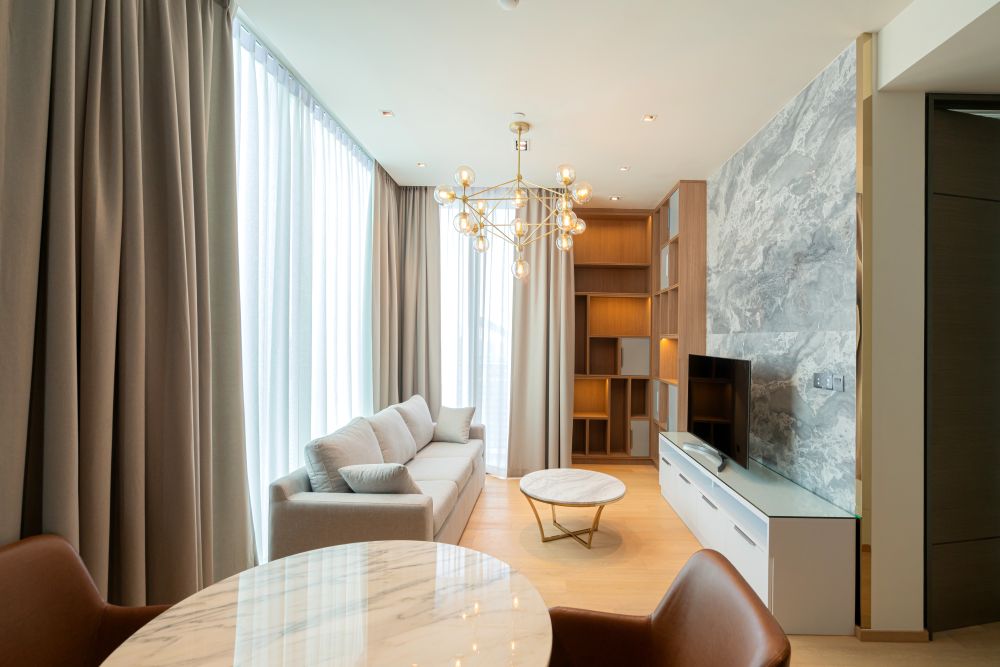
Ten years ago, motorised curtains showed up almost exclusively in show flats and high-end condo penthouses, treated as a novelty feature rather than something a regular household would consider. That’s shifted. Walk through a newer BTO estate or a mid-range condo renovation today and motorised tracks turn up in living rooms, master bedrooms, and even bathrooms with frosted glass panels. The reasons have less to do with luxury and more to do with how Singapore homes are actually laid out and lived in now taller windows, smart-home habits already in place, and households where convenience has quietly become a priority rather than an indulgence. What used to be a talking point during a house viewing is turning into a fairly ordinary line item on a renovation quote.
Windows Have Gotten Harder to Reach by Hand
Floor-to-ceiling glass is now standard in many new developments, and wide sliding doors leading to balconies or planter boxes are common in condo layouts. A single curtain track spanning four or five metres is heavy and awkward to draw by hand, especially with a dense blackout or acoustic lining attached. Motorisation solves a mechanical problem first smooth, even movement across a long span before it solves a convenience one, which is part of why it’s become close to a default recommendation for oversized window walls rather than an optional upgrade.
Smart Home Habits Already Exist in the Household
Most households installing motorised curtains today already have some form of home automation running smart lighting, a video doorbell, a voice assistant on the kitchen counter. Adding curtains to that ecosystem is a small step rather than a new habit to build. Curtains that open on a schedule at sunrise or close automatically at dusk fit into routines people already have, and integration with existing voice assistants or a single home app means one more device joins a system instead of requiring a separate app just for window coverings. Some households take it a step further and link the curtains to a sensor, so blackout panels close automatically once indoor light or temperature crosses a threshold in the afternoon, without anyone needing to remember to do it manually.
A Practical Safety Argument, Not Just a Convenience One
Pull cords and chains on manual tracks are a recognised hazard for young children and pets, which is why many parents specifically ask about motorised or cordless options once a toddler starts crawling. Elderly household members benefit too reaching up to draw heavy curtains or bending to adjust a bottom rail becomes unnecessary when a remote or a wall switch does the job. This safety angle rarely gets top billing in marketing but comes up constantly in actual consultations with families.
Cleaner Sightlines Without Visible Hardware
Motorised systems typically hide the motor within the track housing rather than mounting a bulky mechanism where it’s visible, which suits the minimalist aesthetic many homeowners are chasing in open-concept living and dining spaces. Combined with a track that recesses into a ceiling cove, the curtain appears to hang and move with no visible rail at all, an effect that’s difficult to achieve with a manual system and decorative finials. Interior designers working on show units and full renovations lean on this detail often, since a hidden track reads as more deliberate and considered than one left exposed above the window frame.
What to Check Before Committing
Not every setup is a clean fit for motorisation. Households need to confirm there’s a power point near the track location, decide between battery-operated and hardwired units, and check that the existing or planned track can bear the curtain’s weight at motor speed without straining. Anyone comparing options should look closely at what a motorised curtain track system actually includes some setups bundle the motor, remote, and app hub together, while others require separate purchases that add up quickly once installation is factored in.
Renovation Contractors Are Recommending It Earlier
Interior designers and contractors now tend to raise motorisation during the electrical planning stage rather than leaving it as a decision to revisit once curtains are being fitted, since retrofitting a power point or hardwiring behind a finished ceiling is far more disruptive than running the cabling before plastering and painting are done. This shift in when the conversation happens has probably done as much for adoption as any change in the technology itself, because it removes the awkward timing problem that used to push motorisation out of reach for anyone who decided on it too late in the renovation.
Cost Has Come Down, Not Just Preference Gone Up
Part of the shift is simply price. Motorised components that were niche imports a decade ago are now produced at a scale that’s brought costs within reach of an average renovation budget, not just premium ones. That drop, more than any single design trend, explains why motorised curtains have moved from an occasional splurge to a line item many homeowners consider standard when budgeting for new curtains, alongside fabric and installation.
The popularity of motorised curtains isn’t really about gadgetry for its own sake. It answers a set of very ordinary problems heavy tracks, safety around children, a desire for a room to look tidy without visible mechanisms that happen to line up neatly with how modern Singapore homes are already built and how their occupants already live day to day. Once a household tries it in one room, the pattern is usually to add it elsewhere on the next renovation cycle rather than go back to a manual track.